

135 GTM frameworks. Zero progress.
Frameworks create a false sense of progress when they replace foundational GTM thinking.

Last time I checked, there are more than 135 GTM frameworks you can actually drown in. Yes, more than enough…
And still, the problems remain the same: weak pipeline, longer sales cycles, rising CAC payback, and channels that don’t scale.
So the question isn’t which framework to add next. It’s whether the foundation is solid enough for any framework to work.
A framework can organize your thinking, but it can’t replace it.
The shortcut trap
Frameworks become popular because they’re useful. But they also become shortcuts for the thinking that should come first.
We assume buyer understanding instead of testing it. We make ICP aspirational instead of evidence-based. We skip positioning and go straight to copywriting.
And when the output doesn’t land, we reach for a new framework instead of looking at what’s underneath.
If your foundation is off, you pay for the same problem twice - first by executing the wrong things, then by trying to fix execution that was misaligned from the start.
3 foundations worth pressure-testing
Before adding more frameworks, go back to these:
1- Buyer research & discovery
The job: replace internal consensus with external evidence.
Before you define ICP, positioning, or motion, you need to understand:
Who the customer really is
Which problems matter most
What forces them to consider change
What options they compare you against
How they evaluate tradeoffs and risks
What has to be true for them to choose you
For early-stage companies, this separates real market pull from founder conviction.
For growth-stage companies, it shows where the motion is working, where it’s breaking, and which segments are getting easier or harder to win.
And because buyer behavior and competitive dynamics shift, it can’t be a one-time project.
2- ICP
The job: turn evidence into focus.
Many teams build ICP as an aspiration: who they want to serve, who could benefit, who they’d love to close. And that’s how ICP gets too broad to be useful.
The better question you should ask is: where can you win most efficiently right now?
For early-stage companies, the Early Customer Profile helps identify which buyers will trust you now, adopt quickly, give useful feedback, and create the proof you need to expand.
For growth-stage companies, ICP should be refined based on actual GTM performance: win rates, sales cycles, retention, expansion potential, and proof points.
3- Positioning before messaging
The job: Create the frame where your messaging makes sense.
If you start with the tagline and the homepage, you’ve started with messaging, not positioning. That’s usually why it doesn’t land, and why rewriting copy rarely fixes it.
Positioning is where you decide who this is really for, what problem you own, what buyers compare you against, and why your approach is different. Messaging is how those decisions show up in words.
When positioning is vague, no amount of copywriting compensates.
When frameworks actually work
Once the foundation is clear, frameworks stop being shortcuts and start being useful, as decision models for specific GTM questions.
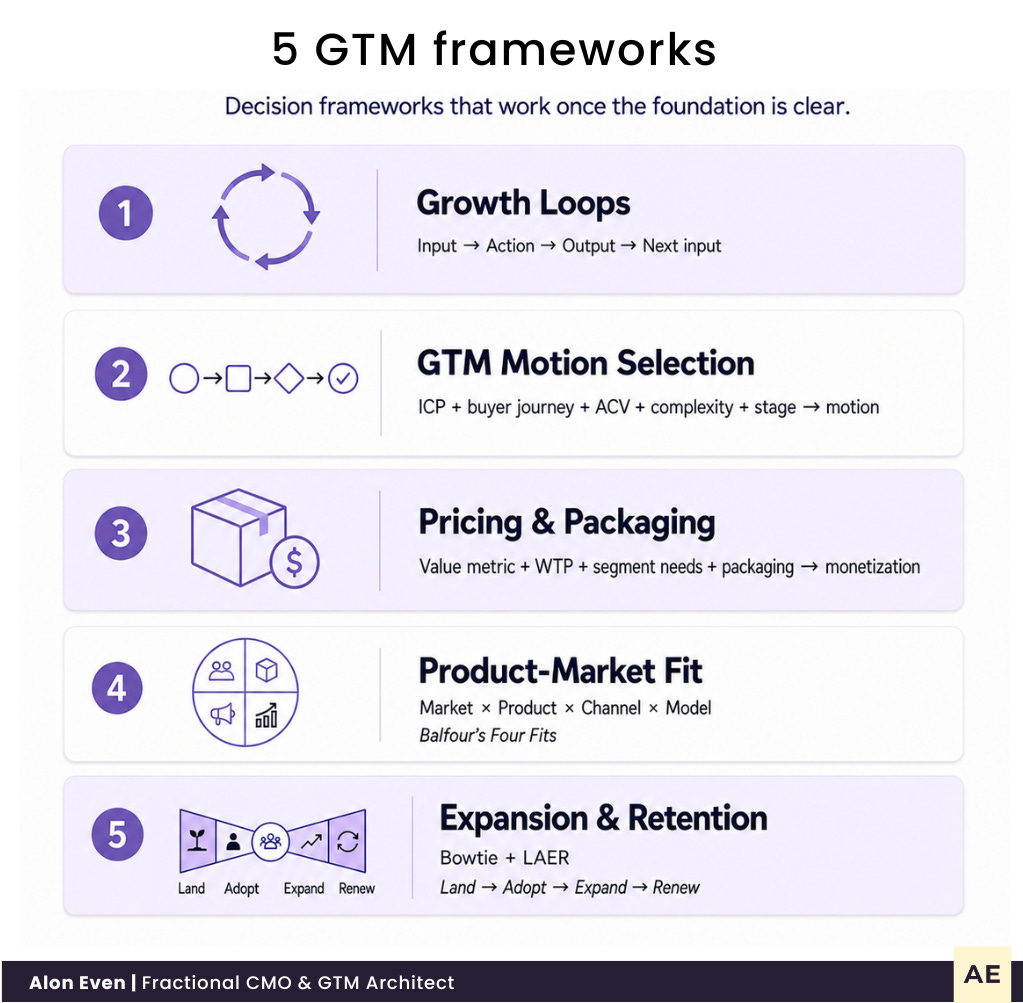
Here are five I see GTM teams actually need:
1- Growth loops
Question: What can compound?
Growth loops follow a simple pattern: Input → Action → Output → Next input
A channel is where you reach the market. A loop is where the output of one motion feeds the next cycle.
Instead of only asking how a lead becomes a customer, ask how one customer can create the next lead: through proof, referrals, collaboration, usage, or advocacy.
But designing the loop requires knowing who triggers it, what motivates the action, and how the output feeds the next cycle. That comes from buyer and ICP clarity.
2- GTM motion selection
Question: How should we go to market?
The right motion comes from a combination of factors: ICP + buyer journey + ACV + product complexity + buyer complexity + resources + stage → primary GTM motion
You don’t pick PLG, sales-led, outbound, or partner-led because it sounds right.
Your buyer, ACV, product friction, resources, and stage set the guardrails.
There are 7 core GTM motions, and I covered them in a separate newsletter on how to choose the right one.
3- Pricing & packaging
Question: How should we capture value?
The monetization model flows from: Value metric + willingness to pay + segment needs + packaging logic + expansion path
Pricing is not just what you charge. It’s one of the clearest tests of whether buyers understand and believe the value.
Without a clear ICP and value frame, pricing attracts the wrong buyers, sets the wrong expectations, and creates the wrong expansion signals.
4- Product-market fit (PMF)
Question: Are market, product, channel, and model reinforcing each other?
Balfour's Four Fits map the relationship across four dimensions: Market × Product × Channel × Model
It helps you see whether market, product, channel, and model are aligned or fighting each other.
PMF can’t be measured in the abstract. It has to be defined against a specific ICP, use case, channel, and business model.
The framework gives you structure for the measurement. And the foundation gives you something real to measure against.
5- Expansion & retention
Question: Does growth continue after the sale?
Models: Bowtie + LAER
Bowtie helps you see recurring revenue as one system: acquisition, retention, and expansion.
LAER pressure-tests the post-sale motion: Land, Adopt, Expand, Renew.
In SaaS & AI, the deal is not the finish line. It’s the start line for adoption, value realization, expansion, and renewal.
And that only works if you landed the right accounts to begin with.
In the end, none of these frameworks are wrong.
They’re powerful when the foundation is solid, and expensive when it isn’t.
Between the lines
I came across two numbers recently that should worry every GTM leader:
85% of CMOs say AI adoption is their top priority for 2026, but 53% of GTM leaders say AI has had little to no impact on actual results (Exit Five’s 2026 & 2025 State of B2B GTM reports).
The gap is simple:
Most teams are using AI to move faster inside the system they already have.
But speed doesn’t solve weak assumptions.
If your ICP is unclear, your signals are noisy, your messaging is generic, or your motion doesn’t match how buyers buy, AI just creates more output from the same weak system.
Before asking what AI can automate, ask whether your system is worth scaling.
Thanks for reading & see you next Saturday!
Alon
P.S. New here? Check out the latest topics.
P.P.S. When you’re ready, here are 3 ways I can help you.