

Content got cheaper. Getting considered got harder.
The GTM lever you treat as a marketing activity instead of a pipeline input.

When I talk to B2B SaaS & AI leadership teams, I see the same recurring friction: they treat thought leadership as a nice-to-have content play.
So they judge it by clicks, engagement, and MQLs, even though its real impact happens much earlier in the GTM system.
And that’s the mistake.
Thought leadership isn’t really a content program. Its job is upstream: to shape memory, trust, and consideration before demand appears.
In other words, it’s not just there to publish, but also to build market authority.
And market authority shapes whether you get considered before your buyers ever enter a sales process.
The new constraint isn’t content
The market is flooded with content that checks the right boxes and still sounds like everyone else.
That’s part of the problem. Less than half of B2B decision-makers say the thought leadership they consume is good. Just 15% call it very good.
The advantage is no longer in creating content. It’s in having a perspective worth remembering.
As AI lowers the barriers to content creation, the supply of content explodes, but attention doesn’t. That’s why the bar for real authority rises.
Where shortlists get built
As you know, ~95% of your market isn’t buying right now (according to LinkedIn’s B2B Institute & Ehrenberg-Bass), but that doesn’t mean they’re not paying attention.
They’re forming impressions, building mental shortlists, and deciding who feels credible before the buying process starts.
And the discovery layer is shifting too.
AI search, AI Overviews, and zero-click results mean buyers increasingly get answers without ever reaching your site.
So if your perspective shows up there, you have visibility before the conversation starts. If it doesn’t, you risk being invisible while buyers are still forming opinions.
And that’s where thought leadership does its real work, not by generating a lead this week, but by building authority before demand appears.
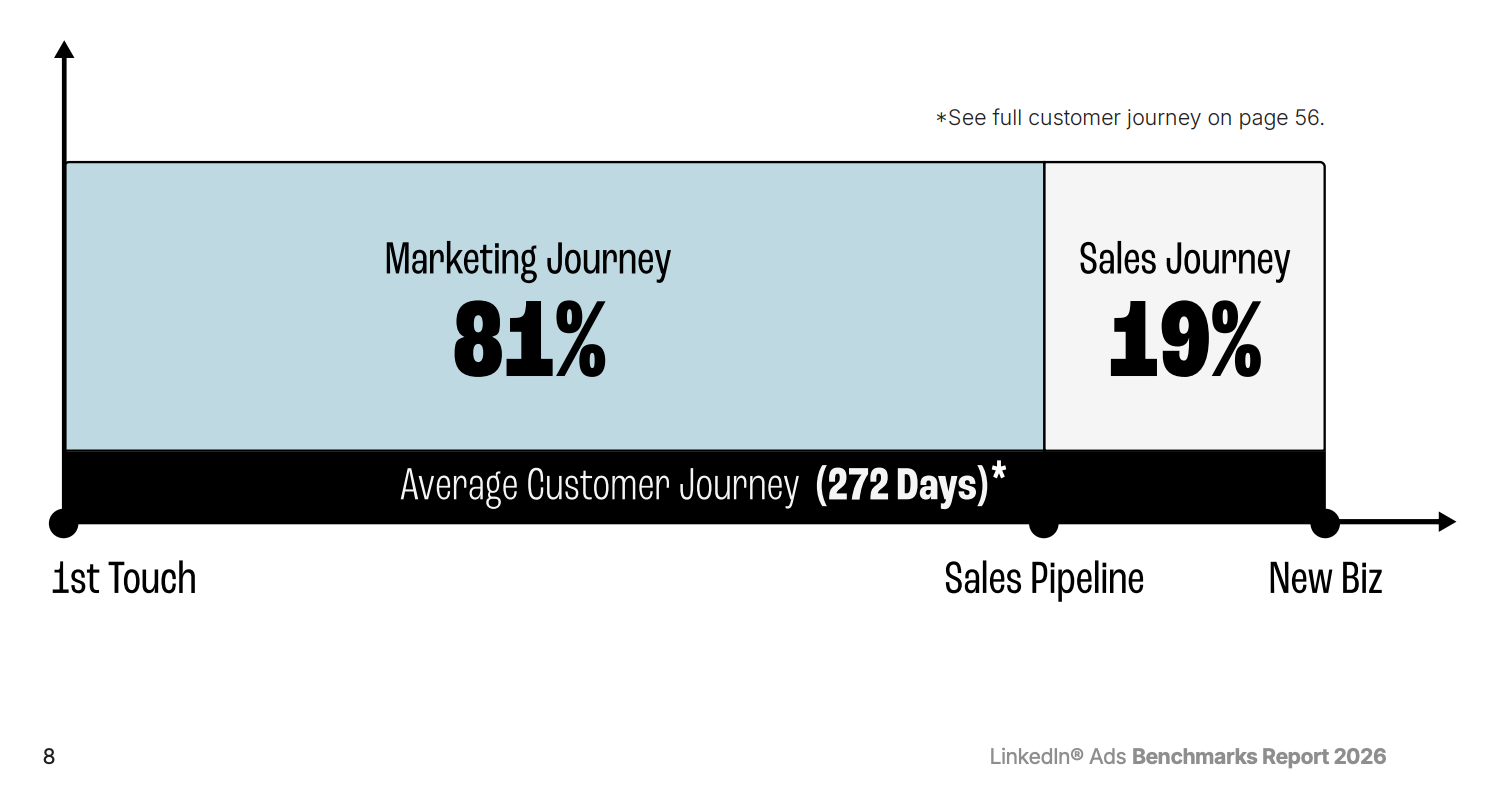
Dreamdata’s latest data reinforces the point: 81% of the B2B journey now happens outside the sales pipeline, up from 70% last year. By the time buyers surface, much of the real decision work is already done.
Why consistency is a systems question
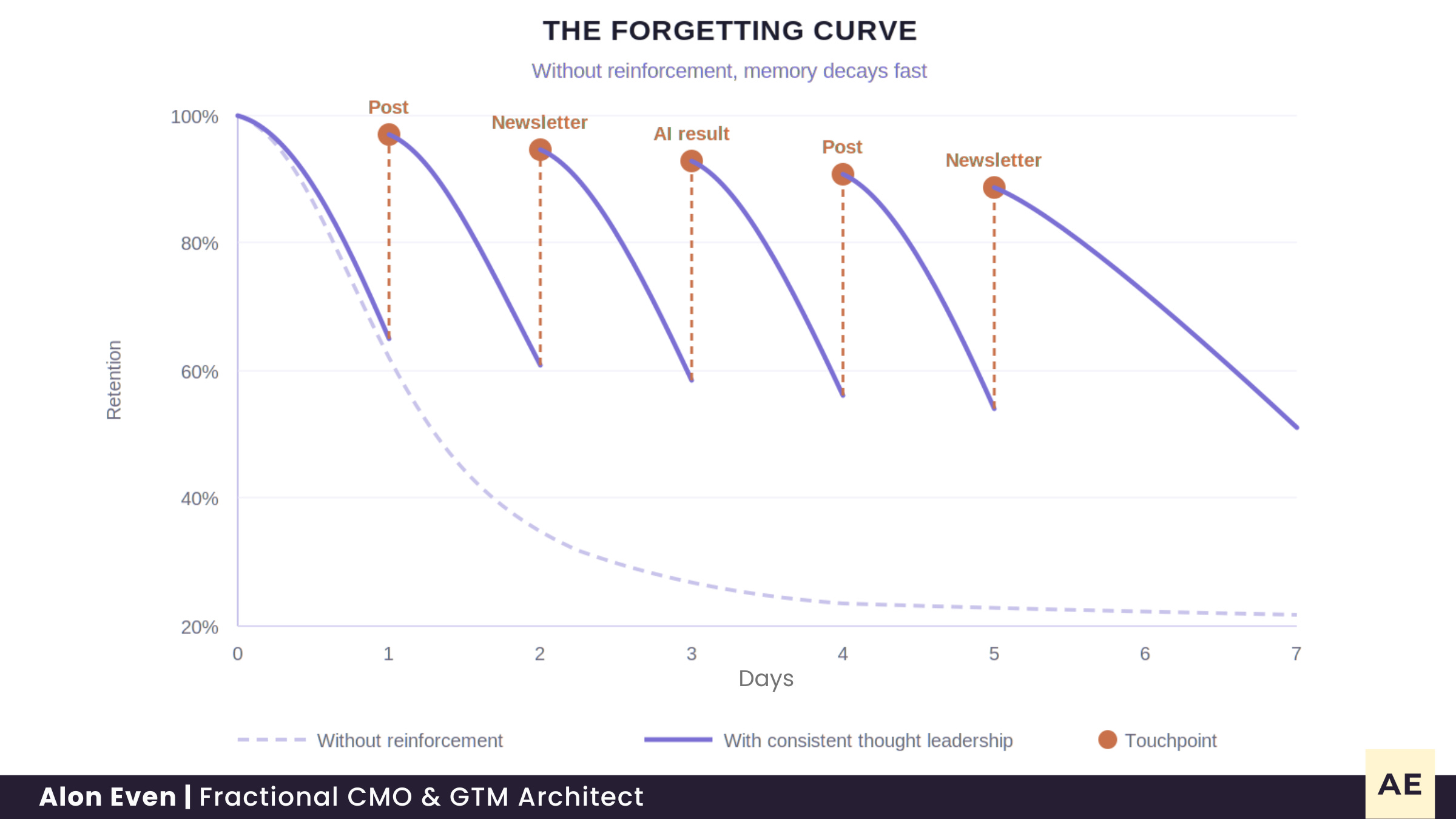
Authority doesn’t get built in one post, but through repeated exposure, the kind that makes buyers remember you, connect you to the right problem, and trust you enough to bring your name into a conversation you’ll never hear.
Without reinforcement, people forget.
The forgetting curve, mapped by Ebbinghaus over a century ago, shows how fast memory decays without repetition. And today, there’s far more competing for that memory as AI floods the market with more sameness.
That’s why bursts don’t compound, and repetition does.
The 2024 Edelman-LinkedIn data puts a number on it: 23% of decision-makers who regularly consumed a company’s thought leadership began buying from them.
So, if you want to build real authority, don’t treat thought leadership like a campaign. Build it into your GTM system.
What to do differently
Here’s how you integrate authority into the GTM system:
1. Move from topic coverage to point of view
If your content is built only around keywords, you are competing on volume. If it is built around a point of view your buyers really care about, you are competing on insight. And if it does not connect to the friction they actually deal with, more distribution will not help. It will just add to the noise.
2. Build repeated exposure, not one-off bursts
Authority doesn’t come from one good post. It comes from buyers seeing the same clear point of view repeatedly across the channels where they already spend time — LinkedIn, newsletters, peer conversations. And when it makes sense, use paid amplification of what is already resonating.
3. Measure it the right way
Stop expecting clean direct attribution in a non-linear journey. You should track leading indicators of authority like branded search growth, direct traffic, AI visibility, and social mentions. Then connect those over time to lagging outcomes like pipeline velocity, win rates, CAC/payback, and revenue.
4. Operationalize the perspective
If thought leadership only happens when someone has spare time, it is not a strategy. Treat it like part of the GTM system: with a clear owner, a real cadence, and enough structure to compound over time.
That’s how thought leadership stops being content and starts becoming market authority.
In crowded markets, pipeline is the visible output. Authority is the invisible input.
And when teams cut the input to protect the output, they usually create the next pipeline problem themselves.
Between the lines
I’ve been digging into AI visibility lately, and one thing stands out.
Semrush just analyzed 89,000 LinkedIn URLs cited by ChatGPT Search, Google AI Mode, and Perplexity.
They found that LinkedIn is now one of the top sources AI search engines rely on for professional queries, and that AI often mirrors LinkedIn’s language closely when it uses it as a source.
Which means consistent thought leadership on LinkedIn can do two things: help your brand show up in AI-driven discovery, and shape the language AI uses to describe you when it does.
You get my point. This is not about content output, but about authority, and most GTM teams still aren’t tracking it that way.
Thanks for reading & see you next Saturday!
Alon
P.S. New here? Check out the latest topics.
P.P.S. When you’re ready, here are 3 ways I can help you.