

PMF collapsing or GTM stuck?
Because “we lost product-market fit” means three totally different things.

Before we jump into today’s topic, two quick things:
First, a big thank you to everyone who joined recently, and to those who’ve been replying with comments, questions, and thoughtful takes. I really appreciate it 🙂
Second, if there’s a specific GTM topic you want me to cover (or a situation you want me to unpack), just hit reply and tell me. I read every response.
Alright, now to our topic.
I don’t know if you’ve noticed, but this is what’s happening right now with product-market fit (PMF):
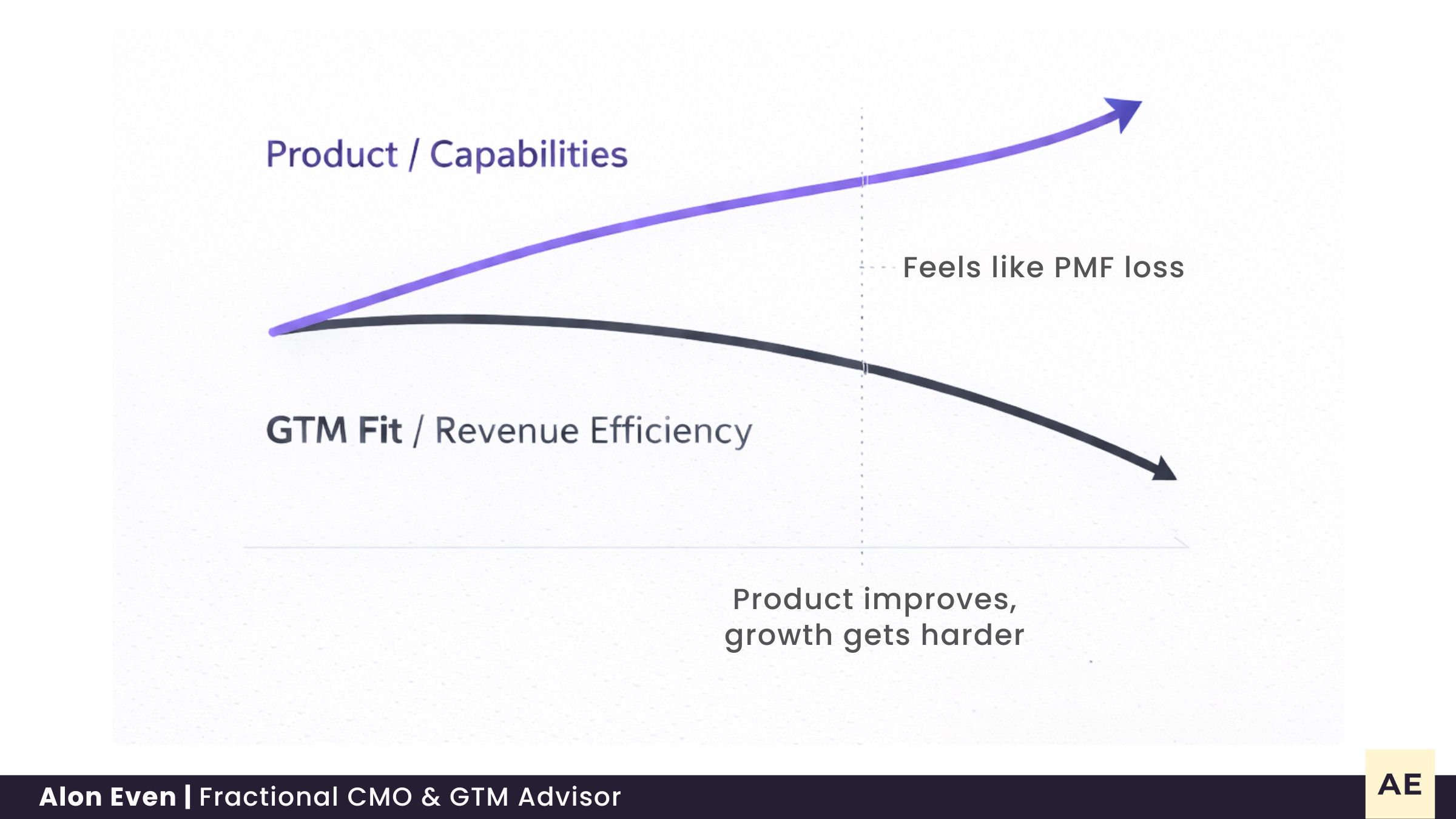
A team hits PMF. Pipeline looks healthy, customers are bought in, and the product is working. Then 6 months later, the product is better, but growth gets harder.
So the question that naturally comes up is: Did we lose PMF?
In AI, sometimes yes. But many teams are mixing up different problems, and reaching for the wrong fix.
3 types of “PMF loss”
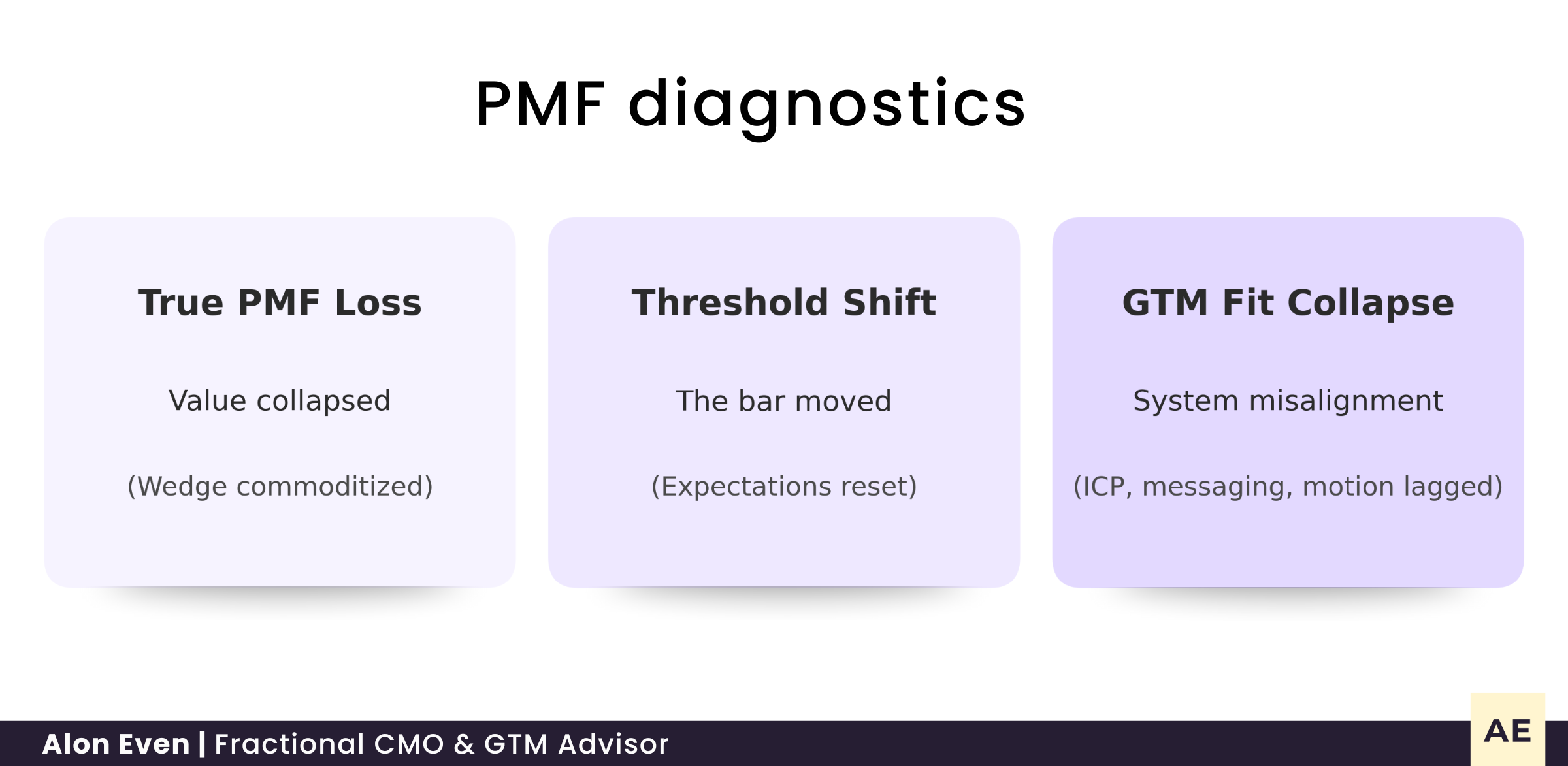
When you say “we lost PMF,” you’re usually describing revenue symptoms. In AI, those symptoms can come from 3 very different realities:
→ True PMF loss
Your wedge gets commoditized or overtaken. A model release makes what you sold as differentiation feel free. At that point, no GTM work fixes value collapse because you need a new wedge.
→ PMF threshold shift
The product still works, but the bar jumped. GPT drops multimodal, and suddenly your “image understanding” feature isn’t a differentiator, it’s the standard.
So the pain still exists, but expectations reset overnight, and the threshold is now much higher.
→ GTM fit collapse
The product improved, but your GTM system didn’t evolve.
Think about the basics like:
- ICP & buyer personas drift
- Messaging stays capability-led while buyers move to outcomes + risk.
- Packaging doesn’t match how value gets evaluated now
- Sales keeps running the old motion in a new market
And yes, it feels like PMF collapse. But in most cases it’s misalignment: GTM stayed static while the market kept moving.
Why this happens faster in AI
AI doesn’t degrade linearly. It moves in jumps. And you can see it everywhere:
Teams ship at warp speed, customers recalibrate what “good” looks like every time a new model drops, and in a lot of categories switching is surprisingly easy.
Meanwhile, as AI moves from “cool” to “critical,” trust becomes the real gate - security, compliance, governance, and vendor viability.
Elena Verna said something that should make every CEO/founder pause: at Lovable, they’re over $100M ARR and still feel like they’re re-earning PMF constantly.
And that’s not a startup phase, but the new reality when the market resets every quarter.
The hidden bottleneck: adoption + trust
In my experience, many teams respond by shipping more. But often the bottleneck isn’t product velocity, but adoption velocity.
Let me explain.
Your AI assistant now has 15 features, and your power users love it. But most customers are still using 3, and now they’re confused by release notes they can’t keep up with.
Product teams can ship faster than customers can adopt. So even if the product is improving, usage doesn’t keep up, and the value doesn’t fully land in the day-to-day workflow.
So, feature velocity ends up higher than adoption velocity.
At the same time, the burden of proof rises. Procurement slows things down, security gets louder, and finance wants ROI, not novelty.
In stable markets, growth teams can build compounding engines.
On the PMF treadmill, the product shifts so fast that last month’s messaging, pitch, and funnel stop working. Growth becomes less about incremental optimization, and more about constantly re-aligning to what’s true right now.
What this really means
PMF in AI behaves less like a milestone and more like a subscription. You don’t “reach it” and move on, you keep renewing it.
Which means the real question isn’t “do we have PMF?”. Instead, you need to ask yourself 3 questions:
1- Did our core value collapse? (Commoditization, leapfrog, wedge elimination)
2- Did the threshold move faster than we did? (New baseline expectations we can’t meet)
3- Did our GTM fall out of sync with how buyers evaluate value now? (Product evolved, market evolved, system stayed stuck)
Because yes, AI companies can actually lose PMF. The wedge can disappear, or the bar can move beyond your reach.
But a lot of what gets labeled “PMF collapse” is actually #3 - GTM fit collapse. The product improved, capabilities expanded, but ICP, messaging, pricing, and sales motion didn’t evolve with it.
In other words: the GTM system around the product is misaligned.
The good news? That version is fixable as long as you diagnose it correctly and address it in the right sequence.
So, you don’t need to rebuild the product. You need to re-architect how you bring it to market.
P.S. I go deeper on this inside my free GTM System Playbook. You can get it here.
Between the lines
I keep hearing the same line in AI lately: competitive moats aren’t durable anymore, but execution moats are.
My take: yes and no… Because execution matters, but not all execution is equal.
Your GTM velocity may be the real moat: re-aligning fast when the market moves, then executing in that direction. Many teams only do the second part, but the edge is doing both.
In the end, even in these crazy times, the GTM foundations haven’t changed, and you can’t skip them. But in AI, those foundations need to be rebuilt every 6 months, not every 3 years.
Thanks for reading & see you next Saturday!
Alon
I'm pretty sure there is another thing at play here in the GTM fit collapse. You touched it very shortly: Trust.
Buyers buy differently. They want you to show them everything before they go into a sales meeting. They evaluate companies very differently and will actively deselect you if you don't play their game.
Buyers hold all the cards, because their options for solving their problem is larger then ever. There is more software than ever, more point solutions, more platforms. And if that fails, you vibe code something into another stack.
So GTM motions that don't look at how buyers buy will per default collapse and I think we are just seeing the start.
The idea of an ICP evolving away from you faster makes a ton of sense right now.
I've also been thinking a lot about differentiators. It used to be that a differentiator was a flag you'd plant for five years. Now, as startups can copy 80% of your differentiation overnight, they seem far less durable.
That's not necessarily a terrible thing. It just is a thing.