

This analysis improves win rates by up to 50%
You're probably already running a win/loss analysis. But fewer than a third do it well, so most miss one of the cheapest growth levers they already own.

Since I can’t read another piece of content about AI anymore, I thought this week we’d talk about a different topic, and I’m sure you’re with me.
So, let’s talk win/loss analysis.
Companies that run win/loss analysis well can see win rates up to 50% higher, but fewer than a third actually do it that way.
Or in simple words, it’s not enough to track why you win and lose. You have to understand whether you really know why you win and lose, and that understanding almost never lives in your CRM.
Which is exactly the difference between treating win/loss as a sales post-mortem and using it as a GTM diagnostic.
Your loss reasons aren’t the full story
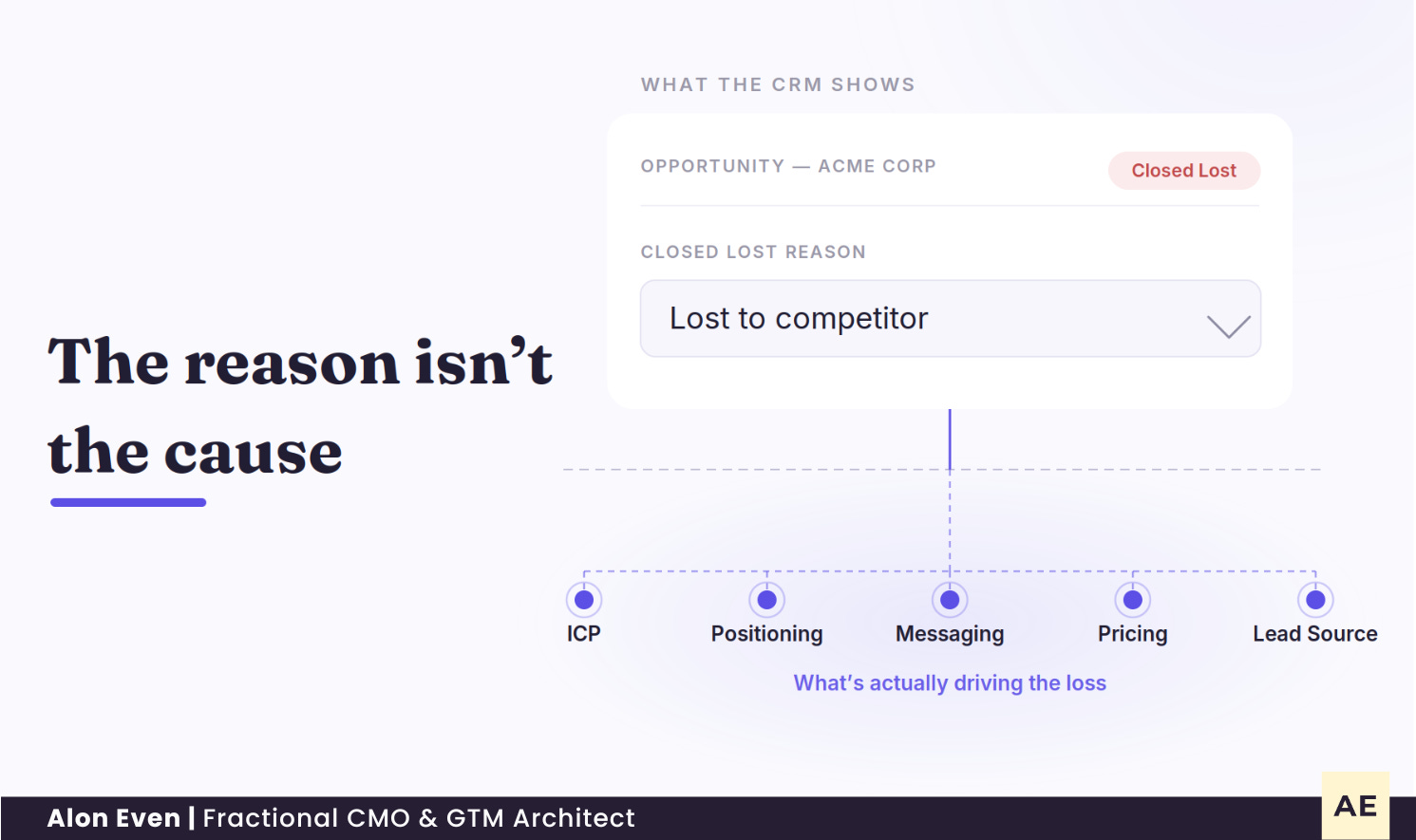
Many GTM teams I work with collect their loss reasons, sort them into buckets, and stop. But the problem is that “lost to a competitor,” “too expensive,” “not a fit,” and “no response” are categories, not causes.
The closed-lost field is useful, but it isn’t the truth. It’s usually the first layer of interpretation, written by a rep who needs to move to the next deal.
And this isn’t about blaming sales. The reason often gets rounded down to the nearest safe category: price, timing, competitor, product, missing functionality, or fit.
The real reason, where the buyer never understood the value or couldn’t explain the difference, rarely gets written down.
Your CRM shows where deals die, not why. So treat the field as the start of the investigation, not the verdict.
The real issue sits upstream
Every loss reason points somewhere upstream in your GTM system. When you read it that way, the same report becomes a diagnosis.
To demonstrate what I mean, here are a few examples:
1- “Too expensive” often isn’t about price. Sometimes the value never landed, which is a positioning problem. Sometimes you were selling to a buyer who was never going to pay, which is an ICP problem.
2- “Went with a competitor” isn’t always about features. More often, the competitor’s story was clearer. Their buyer could explain the difference. Yours couldn’t.
3- “Not in market” or “bad timing” is often a lead-source problem. You pushed a premature lead through the cycle because they downloaded something, not because they were ready to buy.
4- “Missing functionality” can be a real product roadmap gap. Or it can mean you attracted a buyer you were never built for, which sends you straight back to ICP and positioning.
In other words, the same loss report can lead you in two very different directions. You can stop at the sales process, or zoom out to the GTM system behind it.
Won deals tell you who you’re really for
You’ve probably seen this in your own company - losses get most of the attention, but wins are the other half of the diagnostic you can’t overlook.
Won deals tell you your real ICP, meaning who actually buys, not who you think should buy.
They can also reveal your real differentiation, which should feed your positioning & messaging in the buyer’s own words, instead of relying only on internal assumptions (that said, I wouldn’t use this as a replacement for regular buyer interviews).
So, your losses tell you what’s broken, and your wins tell you what to protect.
Start with the data, then validate with buyers
The good news is that your analysis doesn’t need to be complicated.
You need to pull your closed deals from the last year, won and lost, and look for the reasons that keep showing up. Then talk to the buyers behind those deals.
The data gives you the pattern, and talking to your buyers helps you confirm, correct, or sharpen the insight.
And to make it easier, I put together a simple win/loss analysis framework you can use internally:

Between the lines
I’ve run quite a few win/loss analyses with B2B companies at different stages and sizes, and in my experience, even when they analyze win/loss the right way, the hard part is changing the mindset.
Because the findings often require more than a few tactical fixes. They require a shift in how the company thinks about its GTM, and also involve the entire GTM team.
And yes, that’s not easy.
It’s easier to blame price, fit, or timing than to ask harder questions about your value story, ICP, or the urgency you’re creating in the market.
This is why win/loss can be uncomfortable when it’s done well since it challenges the assumptions behind the outcomes.
And that’s exactly why it matters, and why you need to do it intentionally.
Thanks for reading & see you next Saturday!
Alon
P.S. New here? Check out the latest topics.
P.P.S. When you’re ready, here are 3 ways I can help you.
Refreshing. It's so easy to quickly point across the aisle at "the problem" rather than see every win/loss as a pie shared responsibility.